Precious Metal Separation and Purification Method from Solution | Zhengzhou Jinquan
Zhengzhou Jinquan Mining Equipment Co., Ltd. is a professional high-tech enterprise specializing in precious metal refining technology and equipment. We have developed an efficient, high-recovery method to separate and purify platinum (Pt), palladium (Pd) and rhodium (Rh) from aqueous solutions. This method boasts precise process control, excellent separation effects and recyclable adsorbents. Moreover, it applies widely to mining, metallurgy and recycling industries, helping customers maximize the value of precious metal resources.
Below is the detailed step-by-step operation process. It ensures the final product reaches 99.95% purity and maintains high recovery rates for all precious metals, showcasing Zhengzhou Jinquan's professional strength in precious metal refining.
A. Pretreatment of Precious Metal Solution
First, adjust the acidity of the precious metal solution with chemically pure hydrochloric acid. Then, introduce chlorine (Cl₂) for 4 hours of oxidation to fully oxidize the precious metals. After oxidation, heat the solution to 80℃ and keep it at this temperature for 60 minutes to stabilize the precious metals’ chemical state.
After pretreatment, we strictly control the solution’s key indicators. The acidity is 4 mol/L, the volume is 1000 ml, and the potential is 500 mV. The concentration of each precious metal is: Pt 4.5 g/L, Pd 12.7 g/L, Rh 1.0 g/L. This standardized pretreatment provides a solid foundation for efficient subsequent separation.
B. Adsorption Process
Zhengzhou Jinquan uses a high-selectivity adsorbent to target and separate rhodium. The adsorbent consists of silica loaded with 1-ethylpyridinium chloride as the active functional group, with a loading capacity of 1.0 mmol/g. This functional group adsorbs rhodium specifically and effectively from the mixed solution, while leaving platinum and palladium in the solution.
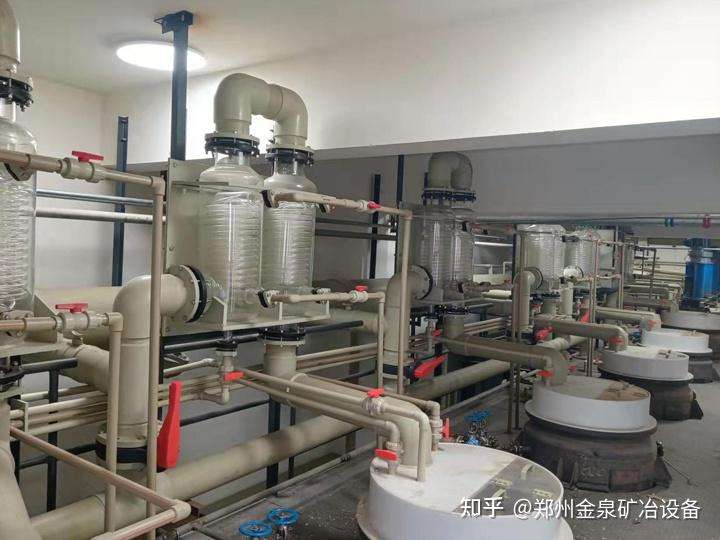
The adsorbent has a particle size of 140-500 μm and a pore size of 100-200 Å, ensuring good permeability and adsorption efficiency. We connect 3 glass adsorption columns in series—each 100 ml in volume and filled with 80 grams of the adsorbent. Let the pretreated solution flow through the columns at room temperature, controlling the flow rate strictly at 10 ml/min. After adsorption, collect the platinum-palladium-containing raffinate into a special container for subsequent separation.
C. Cleaning of Adsorption Columns
To fully recover platinum and palladium and avoid interfering with subsequent rhodium elution, clean the adsorption columns in two steps. First, wash the columns with 240 ml of 6 mol/L hydrochloric acid. Combine this washing solution with the platinum-palladium raffinate to maximize precious metal recovery. Then, rinse the columns with 80 ml of clean water to remove residual hydrochloric acid, creating a clean environment for rhodium elution.
D. Elution and Refining of Rhodium
After cleaning the columns, elute the adsorbed rhodium with 320 ml of 3 mol/L potassium chloride (KCl) solution. Next, adjust the eluent’s pH to 10 with sodium hydroxide (NaOH) solution; this promotes the formation of Rh₂O₃·xH₂O precipitate. Wash the precipitate thoroughly with clean water to remove impurities, dry it, and finally reduce it with hydrogen gas to obtain high-purity sponge rhodium powder.
Test results show the sponge rhodium reaches 99.95% purity and weighs 0.93 grams. Its recovery rate is as high as 93.00%, leading the industry. This fully demonstrates the advanced nature of Zhengzhou Jinquan's precious metal refining technology.
E. Separation of Platinum and Palladium
The raffinate, after rhodium adsorption, is rich in platinum and palladium. Zhengzhou Jinquan uses classic ammonium salt precipitation technology to separate and purify these two metals. This method is mature, stable and efficient. It also has high selectivity and low energy consumption, making it widely used in industrial platinum-palladium separation.
By precisely controlling precipitation conditions, we obtain 4.42 grams of 99.95% pure sponge platinum (98.22% recovery rate) and 12.59 grams of 99.95% pure sponge palladium (99.13% recovery rate). Both the high recovery rate and purity fully meet industrial precious metal application requirements.
F. Regeneration of Adsorbent
To reduce production costs and achieve resource recycling, Zhengzhou Jinquan has designed a scientific adsorbent regeneration process. First, wash the adsorption columns with 240 ml of clean water to remove residual eluent and impurities. Then, equilibrate the columns with 80 ml of 6 mol/L hydrochloric acid to restore the adsorbent’s original performance. The regenerated adsorbent can be directly used for the next batch of precious metal separation, greatly reducing costs and realizing green, efficient production.
Advantages of the Method
Zhengzhou Jinquan's precious metal separation and purification method has obvious industrial advantages. First, the process is standardized and easy to operate, allowing quick application in industrial production. Second, the adsorbent has high selectivity and recyclability, reducing costs and protecting the environment. Third, the product maintains 99.95% purity and stable recovery rates, helping customers maximize precious metal value. Fourth, the entire process operates under mild conditions, with low energy consumption and no secondary pollution, complying with global environmental requirements.
Zhengzhou Jinquan Mining Equipment Co., Ltd. holds 43 patents in precious metal refining technology and equipment. We are also rated as a high-tech enterprise in Henan Province. We are committed to providing professional precious metal separation and purification solutions, including R&D, equipment manufacturing, on-site guidance and technical training. If you have related needs, please contact us for detailed technical support.
 Call us now: